Man From Earth
DJI Avata 360 review by Man From Earth
Unsponsored review · High trust · Independent
Evidence-backed review
It feels like a highly specialized drone designed for creators priorit.
Updated Jul 15, 2026
Buy
Buy if Creators focused on immersive 360 content
High evidence confidence · 97/100
DJI
Camera
Reviewed
29 claims checked across 5 evidence categories
Claims checked: 29 · Verified sources: 6 · Evidence categories: 5 · Open questions: 3 · High evidence confidence · 97/100
We check the product questions most likely to affect a buying decision. Open any item to see the supporting sources, agreement, and limitations.
The camera records 8K/60fps 360 video with a 1-inch sensor, offering best-in-class 360 quality and almost invisible stitching, but cropping reduces effective resolution to ~2.7K, which is worse than the Avata 2.
Moderate agreement · 1 source supports
The Avata 360's control, including head tracking, feels adapted from DJI's FPV systems and is inferior to the Anti-Gravity A1, causing nausea and lacking goggle image quality/detail, while the standard kit provides a regular controller instead of FPV goggles.
Moderate agreement · 1 source supports
The DJI Avata 360 shoots 8K footage in 360 degrees.
Moderate agreement · 1 source supports
When not filming in 360 mode, the Avata 360's normal camera provides better quality than the Avata 2.
Moderate agreement · 1 source supports
The drone is not built for high-quality still photography and only offers bare minimum performance in this area.
Moderate agreement · 1 source supports
The DJI Avata 360 offers superior 360-degree video quality compared to Insta360's offerings in the action camera drone market.
Moderate agreement · 1 source supports
Surpasses Antigr A1 video quality
Moderate agreement · 1 source supports
The Avata 360 produces a very loud motor noise, making it clearly audible from a distance and significantly louder than both the Avata 2 and Anti-Gravity A1.
Moderate agreement · 1 source supports
When using a regular controller, the 360 camera automatically ensures subjects remain in frame regardless of camera orientation, simplifying composition and allowing for both vertical and horizontal formats without quality loss, thereby expanding creative possibilities.
Moderate agreement · 1 source supports
The Avata 360 features 2.9 inch sensors, which is a noticeable improvement over previous models.
Moderate agreement · 1 source supports
The Avata 360 is more accessible for average users compared to traditional FPV drones, requiring less specialized knowledge to operate.
Moderate agreement · 1 source supports
The 360-degree footage requires processing through DJI Studio before it can be used in other editors, which adds an extra step to the workflow, though the software itself is easy to use and includes smart tracking.
Moderate agreement · 1 source supports
Price is less than half of A1's cost
Moderate agreement · 1 source supports
The Avata 360 offers superior execution and a better price point than the Antigravity A1.
Moderate agreement · 1 source supports
The Avata 360's lenses are replaceable via a thread, which proved effective when a scratched lens did not impact image quality.
Moderate agreement · 1 source supports
The Avata 360 is significantly larger and heavier than both the Avata 2 and Anti-Gravity A1, making it feel sketchy to fly near people and receiving negative feedback from other pilots.
Moderate agreement · 1 source supports
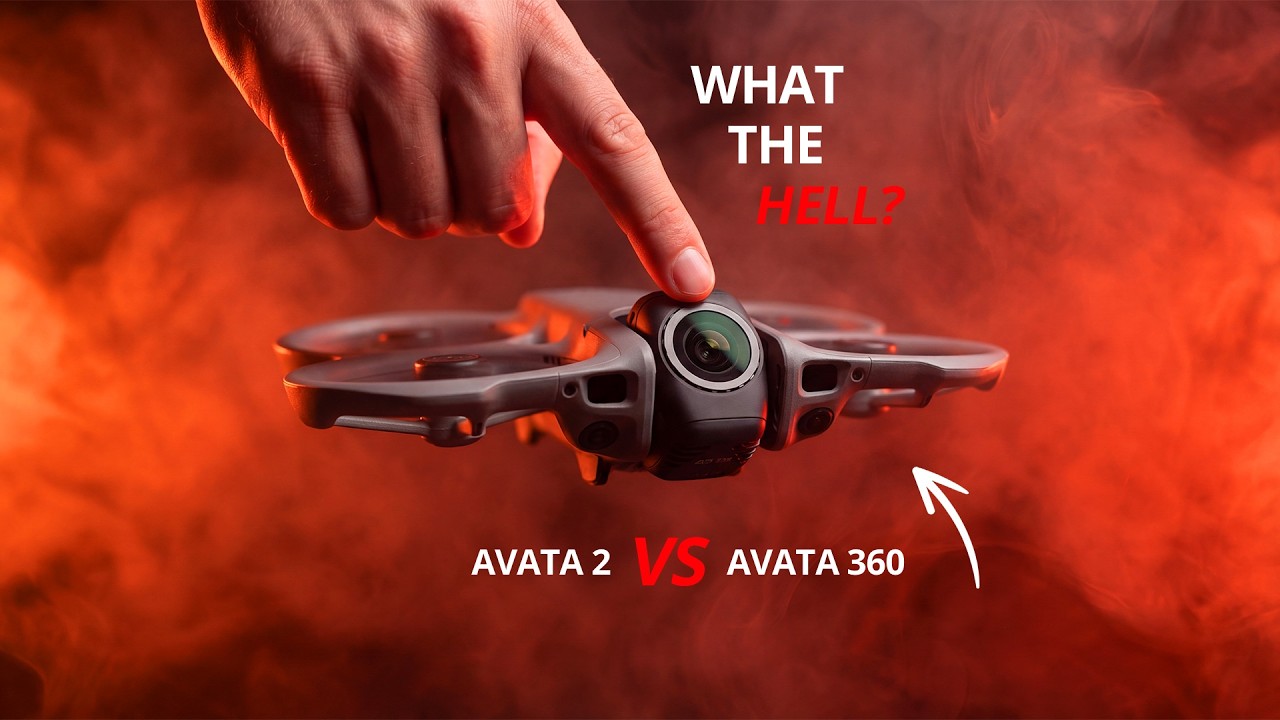
The Avata 360 features a large integrated 360 camera with two ultra-wide 180-degree lenses that automatically rotate for shooting and landing protection, making the drone flat and similar to a built-in Osmo 360 camera.
Moderate agreement · 1 source supports
The Avata 360's single-lens shooting mode offers unimpressive quality, lacks clear gyro recording, and makes ND filter usage difficult, failing to match the Avata 2.
Moderate agreement · 1 source supports
The Avata 360 excels in versatility, allowing diverse angles and creative shots from a single flight, but this freedom introduces significant complexity and time commitment in post-production editing.
Moderate agreement · 1 source supports
The Avata 360 features an advanced tracking mode where it flies ahead of the subject, utilizing front sensors while the camera records backward, described as a 'new level' of tracking.
Moderate agreement · 1 source supports
The drone lacks a 3-axis gimbal in its normal camera mode, leading to instability in windy conditions.
Moderate agreement · 1 source supports
Even when the drone itself is unstable or performing aggressive maneuvers, the 360-degree footage remains consistently stable due to post-capture reframing.
Moderate agreement · 1 source supports
The Avata 360 excels at capturing live events where only one chance is available, as it allows for multiple shots and angles to be extracted from a single 360 capture with acceptable quality.
Moderate agreement · 1 source supports
Captures 8K60 spherical video
Moderate agreement · 1 source supports
Secures Editors' Choice for 360-degree camera drones
Moderate agreement · 1 source supports
Captures 8K/60fps footage and 120MP stills
Moderate agreement · 1 source supports
Extremely affordable
Moderate agreement · 1 source supports
The DJI Avata 360 is the best 360° drone you can buy.
Moderate agreement · 1 source supports
The Avata 360 is the only 360° device to record 8K/60fps footage.
Moderate agreement · 1 source supports
Specific battery life and flight range in diverse conditions.
Limited evidence · What we still need: Seek independent testing data for battery endurance and operational range under various environmental factors.
Clarity on beginner-friendliness and control scheme ease-of-use.
Limited evidence · What we still need: Further independent evaluation is needed to resolve conflicting reports on the learning curve and user control experience.
Long-term durability and performance beyond initial reviews.
Limited evidence · What we still need: Monitor for emerging user reviews and long-term tests on product resilience.
Video reviews and demonstrations that help validate the checked claims.
Man From Earth
DJI Avata 360 review by Man From Earth
Unsponsored review · High trust · Independent
QuickAssTutorials
DJI Avata 360 review by QuickAssTutorials
Unsponsored review · Medium trust · Disclosure not stated
Editorial review · 4 · Creator review · 2
Source timeline for reference.
No evidence items yet.
Insta360
Insta360 X4
Choose for a more portable and versatile 360 camera, if superior drone-based 360 isn't the priority.
Ask labels follow ask-claim-status-v1. How Ask labels a claim →
The DJI Avata 360 is a highly specialized drone designed for creators priorit…