Reinis Kaspars
DJI Mavic 4 Pro review by Reinis Kaspars
Unsponsored review · High trust · Independent
Evidence-backed review
The DJI Mavic 4 Pro emerges as a highly capable drone, particularly for conte.
Updated Jul 15, 2026
Buy
Buy if Content creators seeking versatile, portable gear
High evidence confidence · 96/100
DJI
Camera
Reviewed
27 claims checked across 3 evidence categories
Claims checked: 27 · Verified sources: 4 · Evidence categories: 3 · Open questions: 3 · High evidence confidence · 96/100
We check the product questions most likely to affect a buying decision. Open any item to see the supporting sources, agreement, and limitations.
Mounting the DJI Mavic 4 Pro on a tripod extends its usable battery life for hyperlapses from about 40 minutes (flying) to 2-3 hours, enabling much longer and more comprehensive time-lapse captures.
Moderate agreement · 1 source supports
The Mavic 4 Pro's 6K resolution provides substantial flexibility for cropping footage, allowing for up to 1.5x or 2x zoom without a noticeable degradation in image quality.
Moderate agreement · 1 source supports
The Mavic 4 Pro delivers an image quality that is notably superior to the Mavic 3 Pro, which felt sharper and more digital by comparison.
Moderate agreement · 1 source supports
The drone achieves a "perfect middle ground" in its image, combining softness and sharpness for a cinematic look, coupled with "really, really impressive" dynamic range that allows it to be color-graded similarly to footage from a Sony a7S III.
Moderate agreement · 1 source supports
The Mavic 4 Pro performs exceptionally well in challenging lighting conditions like harsh midday sun, eliminating issues such as banding and color shifts on the horizon that were problematic with the Mavic 3 Pro.
Moderate agreement · 1 source supports
The Mavic 4 Pro produces "insane" and "beautiful" sun stars and flares when light sources pass F2, which significantly enhances the character of the footage, particularly in night scenes or when shooting against the sun.
Moderate agreement · 1 source supports
The Mavic 4 Pro demonstrates a "noticeable improvement" in battery life, estimated at 20-30% better than its predecessor. This improvement means that typically only two batteries are needed per shoot, compared to the three often required with the Mavic 3 Pro.
Moderate agreement · 1 source supports
The fixed apertures on the telephoto cameras (which the reviewer believes are quite large) make it "impossible to expose properly when shooting 25 or 24 FPS" in bright daylight, even with an ND64 filter, necessitating slower shutter speeds for proper exposure.
Moderate agreement · 1 source supports
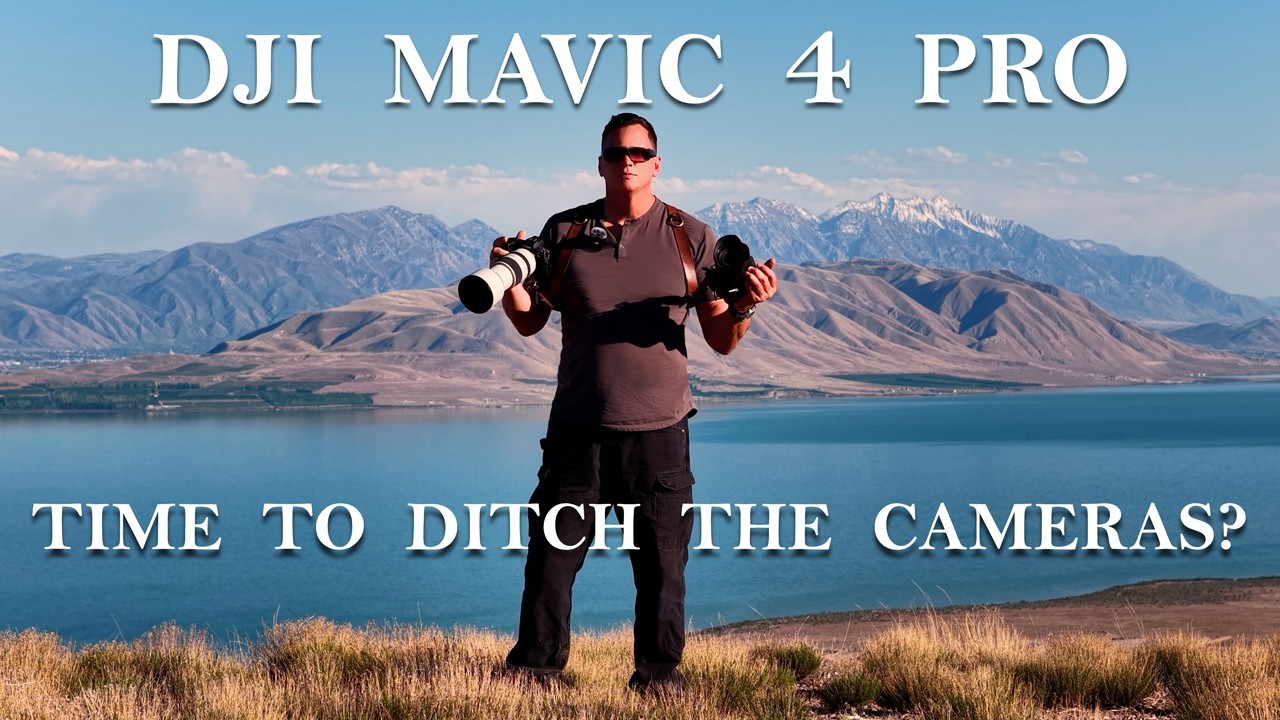
The DJI Mavic 4 Pro can significantly reduce the weight of camera gear a content creator needs to carry, especially when used in place of a traditional DSLR/mirrorless setup with multiple lenses and batteries.
Moderate agreement · 1 source supports
When mounted on a tripod, the DJI Mavic 4 Pro eliminates the delays associated with drone startup and satellite acquisition, allowing for immediate shooting of static shots.
Moderate agreement · 1 source supports
The drone integrates seamlessly with wireless DJI mics via Bluetooth, streamlining the audio setup compared to the more complex transmitter/receiver systems required by traditional cameras.
Moderate agreement · 1 source supports
When used on a tripod and not flying, the DJI Mavic 4 Pro makes no operational noise, avoiding audio interference for static shots and reducing post-production work.
Moderate agreement · 1 source supports
Side-by-side comparison shows the DJI Mavic 4 Pro produces images of comparable quality to a Canon R5, with the drone's images surprisingly offering nearly double the size and dimensions, suitable for larger prints without distortion.
Moderate agreement · 1 source supports
The dual ISO feature allows the drone to capture "really good night shots" that appear fantastic, especially when combined with the star effect on lights. Noise, though present in raw clips, becomes "pretty much invisible" after applying contrast, yielding impressive low-light results.
Moderate agreement · 1 source supports
Dlog-M, when used with Auto ISO, provides more dynamic range than Dlog, preserving more detail and reducing noise in shadows. However, it is disliked for its sharper, more digital look compared to Dlog's cinematic softness, and the Auto ISO requirement causes exposure shifts during certain movements.
Moderate agreement · 1 source supports
The Mavic 4 Pro is "bigger, thicker, chunkier" and weighs over a kilogram, making it 20-25% larger than the Mavic 3 Pro. This increased size and weight negatively impacts its portability, often requiring a dedicated satchel for travel.
Moderate agreement · 1 source supports
The feature that automatically powers on the drone when its arms are unfolded is a design choice the reviewer strongly dislikes, finding it inconvenient for simple tasks like swapping batteries without needing to fully activate the drone.
Moderate agreement · 1 source supports
The DJI Mavic 4 Pro's controller allows for real-time monitoring and remote adjustment of the gimbal, enabling perfect framing without repeatedly approaching the camera, a distinct advantage over conventional cameras.
Moderate agreement · 1 source supports
The DJI Mavic 4 Pro can instantly switch to vertical shooting mode digitally, which is a significant time-saver compared to manually reorienting a conventional camera on a tripod.
Moderate agreement · 1 source supports
The DJI Mavic 4 Pro comes with three built-in lenses (168mm, 70mm, 28mm) that can be switched remotely, eliminating the need to physically change lenses and filters, saving time and fostering creativity.
Moderate agreement · 1 source supports
The 6X telephoto camera on the Mavic 4 Pro has received "major improvements" and is now "actually usable in most lighting conditions," allowing for advanced post-processing like day-to-night grading.
Moderate agreement · 1 source supports
The new RC2 remote is a significant upgrade, being "a lot more snappier" and offering "really good range" due to its physical antennas, directly addressing the lagging, slow feedback, and poor range issues of the previous RC1 remote.
Moderate agreement · 1 source supports
Shoots 6K/60fps video with Hasselblad camera
Moderate agreement · 1 source supports
Captures 100MP stills
Moderate agreement · 1 source supports
Not available in the U.S. at global launch
Moderate agreement · 1 source supports
The DJI Mavic 4 Pro is the best consumer drone money can buy right now, period.
Moderate agreement · 1 source supports
The DJI Mavic 4 Pro will not be available for sale in the U.S. upon its global launch.
Moderate agreement · 1 source supports
Long-term durability of the drone components beyond one year of use.
Limited evidence · What we still need: Seek independent reviews or user reports detailing reliability over 2+ years of use.
Detailed performance metrics and comparisons of obstacle avoidance systems in complex environments.
Limited evidence · What we still need: Look for specific stress tests or comparisons of the obstacle avoidance features.
Quantitative data or comparisons regarding the drone's noise levels during operation.
Limited evidence · What we still need: Search for reviews that specifically measure or comment on flight noise.
Video reviews and demonstrations that help validate the checked claims.
Reinis Kaspars
DJI Mavic 4 Pro review by Reinis Kaspars
Unsponsored review · High trust · Independent
New Adventure Films
DJI Mavic 4 Pro review by New Adventure Films
Unsponsored review · High trust · Independent
Editorial review · 2 · Creator review · 2
Source timeline for reference.
No evidence items yet.
Autel
Autel Evo Lite+
Consider Autel Evo Lite+ for a strong alternative with a 1-inch sensor, excellent low-light, and competitive flight features.
Sony
Sony Airpeak S1
Professionals needing interchangeable lenses and more robust cine capabilities might find the Sony Airpeak S1 a superior, albeit more expensive, option.
Ask labels follow ask-claim-status-v1. How Ask labels a claim →
The DJI Mavic 4 Pro emerges as a highly capable drone, particularly for conte…