Niclas Nilsson
DJI Lito X1 review by Niclas Nilsson
Unsponsored review · High trust · Independent
Evidence-backed review
The DJI Lito X1 emerges as a highly capable and accessible drone, particularl.
Updated Aug 16, 2026
Wait
Buy if Beginner Drone Pilots
Wait or skip if Long-term durability and reliability of components under varied environmental conditions.
Medium evidence confidence · 68/100
DJI
Drone
Reviewed
34 claims checked across 6 evidence categories
Claims checked: 34 · Verified sources: 14 · Evidence categories: 6 · Open questions: 4 · Medium evidence confidence · 68/100
We check the product questions most likely to affect a buying decision. Open any item to see the supporting sources, agreement, and limitations.
The Lito X1 model has a larger 1/1.3-inch sensor for improved video quality and low-light performance, and a LiDAR sensor on the front for enhanced obstacle avoidance.
Moderate agreement · 1 source supports
The Lito offers a standard battery providing 36 minutes of flight time, and an optional 'plus' battery that extends flight to 52 minutes (though it makes the drone over 250g).
Moderate agreement · 1 source supports
The Lito can capture video in 4K at 60fps or 100fps for slow motion, supports 10-bit Dlog-M for color grading, and records vertical video at up to 2.7K.
Moderate agreement · 1 source supports
The drone supports off-state quick transfer, enabling users to transfer content from internal memory or an SD card to a mobile device without powering on the drone.
Moderate agreement · 1 source supports
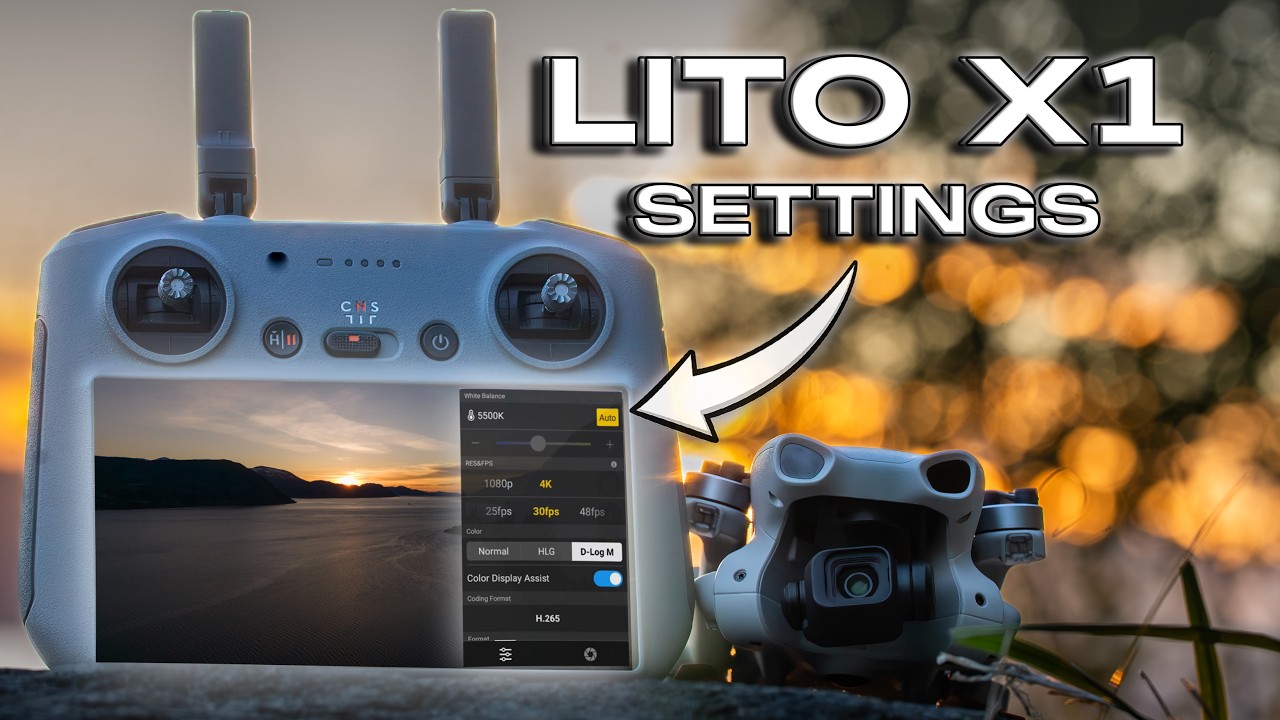
The reviewer claims that common frame rates like 24 or 25 fps cause drone footage to stutter, recommending 30fps instead to eliminate this issue while maintaining a natural film look.
Moderate agreement · 1 source supports
To achieve a natural motion blur, the reviewer emphasizes following the 180-degree shutter rule (shutter speed at double the frame rate). He also highlights ND filters as a 'must-have' to maintain this rule and achieve correct exposure during daylight.
Moderate agreement · 1 source supports
The reviewer notes that 4K 100fps slow motion offers superior quality compared to 1080p 200fps on the Lito X1. However, for the absolute best slow-motion results, he recommends shooting in 4K 60fps in regular video mode and slowing it down to 40% in editing software.
Moderate agreement · 1 source supports
For maximum flexibility and detail in photography, the reviewer advises shooting in RAW format with a 4x3 aspect ratio (to use the full sensor) and 48 megapixels. However, for low-light scenes, 12 megapixels will produce a cleaner image.
Moderate agreement · 1 source supports
The reviewer highlights the importance of specific adjustments in Cine mode's gain and expo tuning, such as setting a low max angular velocity (20 deg/sec), specific yaw smoothness (around 12), high brake sensitivity (80-100), extremely low expo values, low gimbal tilt speed (10 deg/sec), and max tilt smoothness, to ensure smooth, controlled, and cinematic drone shots.
Moderate agreement · 1 source supports
While auto settings might provide slightly more dynamic range, the reviewer warns that they cause inconsistent exposure changes throughout a shot and drift from the 180-degree shutter rule. He offers a workaround by locking exposure (tap and hold the screen) and adjusting the EV meter to correct brightness in auto mode.
Moderate agreement · 1 source supports
Equipped with a 1/1.3-inch 48MP sensor, the drone produces impressive footage with good color, detail, and dynamic range. It supports 4K 60fps HDR and 4K 100fps slow motion video.
Moderate agreement · 1 source supports
The standard battery kit, rated for 36 minutes, provides a practical real-world flight time of 26 to 30 minutes, allowing for relaxed and unhurried shooting sessions.
Moderate agreement · 1 source supports
With the standard battery, the DJI Lito comes in under 249 grams, which is significant for regulatory compliance in many regions.
Moderate agreement · 1 source supports
The reviewer states that to extract the absolute best quality from the DJI Lito X1, users must shoot in D-Log M, acknowledging that this necessitates learning color grading techniques.
Moderate agreement · 1 source supports
The reviewer advises maintaining the lowest possible ISO setting to achieve the cleanest image, as increasing ISO will introduce noticeable noise in darker areas of the footage.
Moderate agreement · 1 source supports
The reviewer recommends enabling the overexposure warning (zebra stripes) to prevent blown highlights and using the grid for better composition. Additionally, he suggests reducing sharpness and noise reduction to 2 in style settings to achieve a more natural 'film look' and avoid a 'digital look' common with DJI drones.
Moderate agreement · 1 source supports
The DJI Lito X1 is exceptionally lightweight (249g) and portable, making it easy to carry for long distances and reducing the friction associated with bringing a drone on outdoor activities.
Moderate agreement · 1 source supports
ActiveTrack on the Lito X1 is highly usable in real-world scenarios due to its integration with obstacle sensing, simplifying cinematic moving shots and lowering the learning curve for beginners.
Moderate agreement · 1 source supports
The inclusion of a 10-bit Dlog-M color mode provides greater flexibility for professional color grading, an advanced feature for a beginner-focused drone.
Moderate agreement · 1 source supports
Despite its small size, the Lito X1 handles darker scenes surprisingly well, offering commendable low-light performance for its category.
Moderate agreement · 1 source supports
The drone is easy and smooth to fly.
Moderate agreement · 1 source supports
The RC 2 controller provides a smooth and responsive live view, maintaining a solid and stable connection even at longer distances, with a transmission range up to 15km.
Moderate agreement · 1 source supports
The DJI Lito series offers advanced flight features and capabilities typically found in higher-end drones, but at an incredibly affordable price point, making it suitable for beginners.
Moderate agreement · 1 source supports
Camera performance is very good for the price.
Moderate agreement · 1 source supports
Some units feel cheaply built or flimsy.
Moderate agreement · 1 source supports
The Lito series features 360° omnidirectional obstacle avoidance, enhancing flight safety.
Moderate agreement · 1 source supports
The Lito series features an advanced return to home system capable of navigating complex environments and obstacles like tree canopies to safely return to its home point.
Moderate agreement · 1 source supports
The drone is highly beginner-friendly due to its omnidirectional obstacle sensing and forward-facing lidar system, which boost confidence by automatically helping avoid collisions, especially in low light or during return-to-home flights.
Moderate agreement · 1 source supports
ActiveTrack 360 allows the drone to track subjects autonomously and be maneuvered 360° around them, utilizing obstacle avoidance during the process.
Moderate agreement · 1 source supports
The reviewer asserts that using auto white balance is detrimental to drone footage because it leads to color temperature changes in the middle of a shot, making the footage inconsistent.
Moderate agreement · 1 source supports
Obstacle avoidance is impressive and a major selling point.
Moderate agreement · 1 source supports
DJI Lito X1 is not available in the US market, so it is excluded from US best-drone buying guides.
Moderate agreement · 1 source supports
The closest current alternatives in buying guides are compact DJI models such as the Mini 4 Pro, Neo, and Flip.
Moderate agreement · 1 source supports
HoverAir X1 Pro is positioned as a DJI alternative rather than a direct DJI competitor in the same ecosystem.
Moderate agreement · 1 source supports
Long-term durability and reliability of components under varied environmental conditions.
Limited evidence · What we still need: Seek out long-term user reports or extended review testing beyond 30 days.
Direct performance comparisons against key non-DJI competitor drones in the same category.
Limited evidence · What we still need: Look for comparison reviews that specifically pit the Lito X1 against alternative brands.
Evidence on battery degradation over multiple charge cycles and extended usage.
Limited evidence · What we still need: Monitor battery performance closely and consider purchasing extra batteries.
In-depth review of all advanced intelligent flight modes beyond ActiveTrack 360, including specific performance metrics and limitations.
Limited evidence · What we still need: Consult the official manual for a complete list and demonstration videos from users.
Video reviews and demonstrations that help validate the checked claims.
Niclas Nilsson
DJI Lito X1 review by Niclas Nilsson
Unsponsored review · High trust · Independent
Air Photography
DJI Lito X1 review by Air Photography
Unsponsored review · High trust · Independent
Ian Worth
DJI Lito X1 review by Ian Worth
Sponsored demo · Medium trust · Sponsored
Owner reports · 12 · Creator review · 3
Source timeline for reference.
No evidence items yet.
DJI
DJI Mini 3 Pro
Offers a similar sub-250g form factor with excellent features, potentially at a lower price point.
Autel
Autel Evo Nano+
A strong competitor to DJI Mini series, known for good camera quality and compact design.
DJI
DJI Air 3
For those needing dual cameras and longer flight times, willing to accept a larger, heavier drone.
Ask labels follow ask-claim-status-v1. How Ask labels a claim →
The DJI Lito X1 emerges as a highly capable and accessible drone, particularl…