Linus Tech Tips
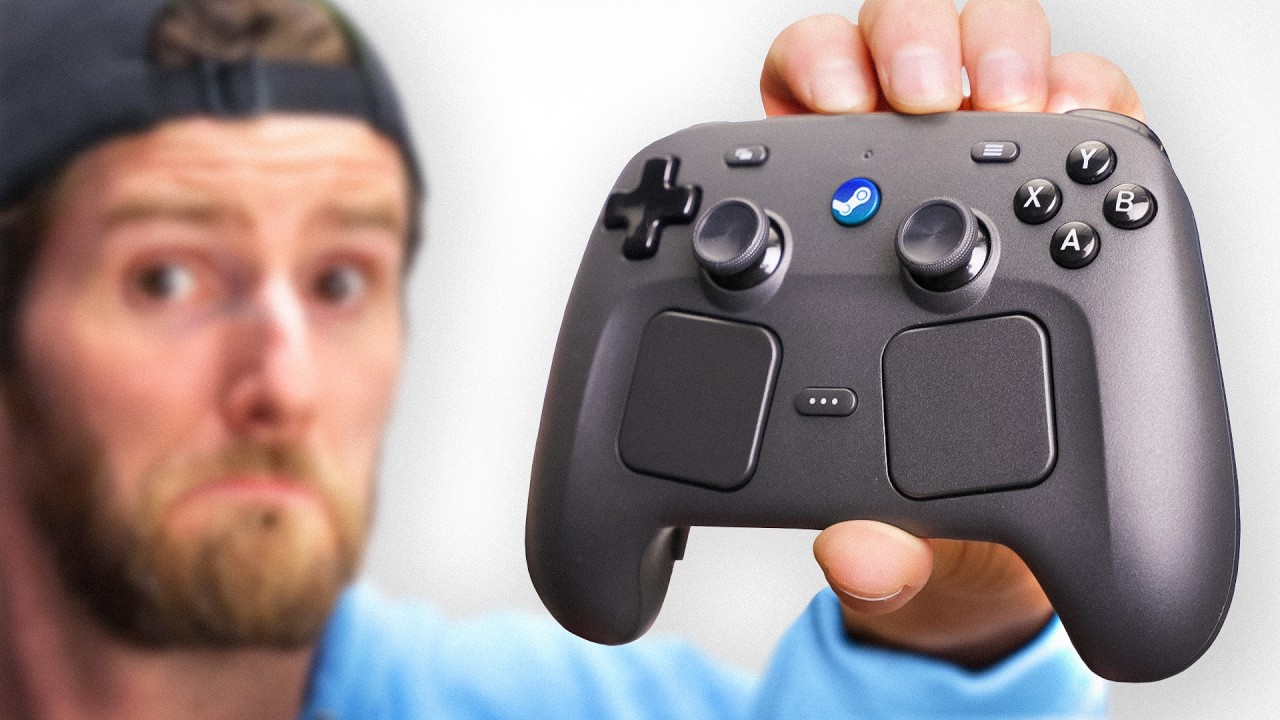
Steam Controller review by Linus Tech Tips
Unsponsored review · High trust · Independent
Evidence-backed review
The aggregated evidence strongly positions the Steam Controller as a highly c.
Updated Jul 20, 2026
Buy
Buy if PC gamers seeking extensive input customization.
High evidence confidence · 91/100
Valve
Gaming
Reviewed
24 claims checked across 6 evidence categories
Claims checked: 24 · Verified sources: 4 · Evidence categories: 6 · Open questions: 3 · High evidence confidence · 91/100
We check the product questions most likely to affect a buying decision. Open any item to see the supporting sources, agreement, and limitations.
The Steam Controller 2 demonstrates excellent input latency, performing 'really, really well' in lab tests. The reviewer states that 'no one's going to be bothered by the latency,' indicating a highly responsive gaming experience.
Moderate agreement · 1 source supports
The DualSense Edge's adaptive triggers offer unparalleled strength, precision, and feel, a feature completely absent from the Steam Controller.
Moderate agreement · 1 source supports
The DualSense Edge demonstrates a response time that is twice as fast as the Steam Controller, making it a better choice for competitive gaming.
Moderate agreement · 1 source supports
The Steam Controller offers substantially longer battery life, lasting almost two days on a single charge, compared to the DualSense Edge's approximately four hours.
Moderate agreement · 1 source supports
The Steam Controller provides four comfortable and usable rear buttons, which are preferred over the DualSense Edge's two main rear buttons and two poorly placed additional buttons.
Moderate agreement · 1 source supports
The Steam Controller is generally more comfortable for extended use, while the DualSense Edge's boxy design can lead to discomfort and hand pain.
Moderate agreement · 1 source supports
The controller features Tunnel Magnetoresistance (TMR) joysticks, which combine the advantages of both Hall effect and potentiometer joysticks, offering outstanding precision, great reliability (eliminating drift), and low power consumption.
Moderate agreement · 1 source supports
The controller's plastic body feels somewhat cheap, and its handle angle and thumbstick placement can be a bit of a reach or lead to accidental presses for some users, particularly those with smaller hands. Screw holes on the bottom may also affect comfort.
Moderate agreement · 1 source supports
A major highlight is the included wireless 2.4 GHz puck which acts as both a dongle and a charging dock, eliminating the need for constant cable plugging and reducing port wear. It can also pair up to four controllers.
Moderate agreement · 1 source supports
The Steam Controller features superior Anti-Stick Drift TMR sticks with higher resolution and lower tension out of the box, whereas the DualSense Edge uses less reliable potentiometer sticks that require expensive, frequent replacement.
Moderate agreement · 1 source supports
The Steam Controller offers a significantly better price-to-performance ratio than the DualSense Edge, which is often twice the price and does not justify its cost with its limited advantages.
Moderate agreement · 1 source supports
The Steam Controller, combined with Steam Input, allows for extensive customization of control schemes, including the use of community configurations and flexible gyro aiming activation, even in games without native remapping support.
Moderate agreement · 1 source supports
The new Steam Controller features Valve's best haptic trackpads yet, with an enlarged, flatter design from the Steam Deck. They are a 'lifesaver' for navigating non-controller-optimized PC experiences and even playing games that don't natively support controllers, such as RTS titles.
Moderate agreement · 1 source supports
The thumbsticks provide a good tactile feel, comparable to an Xbox controller, featuring raised textured edges and a flat smooth middle. They also include capacitive sensors for activating six-axis motion controls.
Moderate agreement · 1 source supports
The triggers offer adequate resistance but do not include haptic rumble (like Xbox), adaptive resistance (like DualSense), short/long travel toggles, or the two-stage activation found in the original Steam Controller, making them 'uninspired'.
Moderate agreement · 1 source supports
The Steam Controller delivers more detailed haptic feedback, while the DualSense Edge's stronger motors paradoxically lead to a loss of fine detail.
Moderate agreement · 1 source supports
The Steam Controller's dual touchpads are better for aiming and can be twice as accurate as traditional thumbsticks, especially when combined with gyro assistance.
Moderate agreement · 1 source supports
The DualSense Edge's gyro features a smoothing algorithm for easier small adjustments, while the Steam Controller's capacitive touch allows for easier activation.
Moderate agreement · 1 source supports
The Steam Controller, leveraging Steam Input, offers far more customization features on PC compared to the DualSense Edge, whose software options are more limited.
Moderate agreement · 1 source supports
Works with all Steam games regardless of OS
Moderate agreement · 1 source supports
The Steam Controller is my favorite gamepad
Moderate agreement · 1 source supports
Long-term physical durability of the controller, beyond joystick reliability, is not thoroughly documented.
Limited evidence · What we still need: Seek reviews addressing build material resilience, drop tests, or long-term wear patterns.
Detailed comparisons against a wider range of mainstream controllers (e.g., Xbox, Nintendo Pro) are limited.
Limited evidence · What we still need: Look for comparative reviews covering more diverse competitor models and features.
Specific data on the latency differences between wireless 2.4 GHz and wired connections is not provided.
Limited evidence · What we still need: Investigate if wired mode offers any measurable input latency improvement over wireless.
Video reviews and demonstrations that help validate the checked claims.
Linus Tech Tips
Steam Controller review by Linus Tech Tips
Unsponsored review · High trust · Independent
vCuda
Steam Controller review by vCuda
Unsponsored review · Medium trust · Disclosure not stated
Editorial review · 2 · Creator review · 2
Source timeline for reference.
No evidence items yet.
Sony
DualSense Edge
Shoppers might prefer this for its superior adaptive triggers and potentially a more premium feel, despite its higher price.
Microsoft
Xbox Elite Wireless Controller Series 2
Offers high-end build quality, modular components, and deep customization within the Xbox ecosystem.
8BitDo
8BitDo Ultimate Bluetooth Controller
A more affordable option providing Hall Effect joysticks and a charging dock, offering great value for PC and Switch.
Ask labels follow ask-claim-status-v1. How Ask labels a claim →
The aggregated evidence strongly positions the Steam Controller as a highly c…